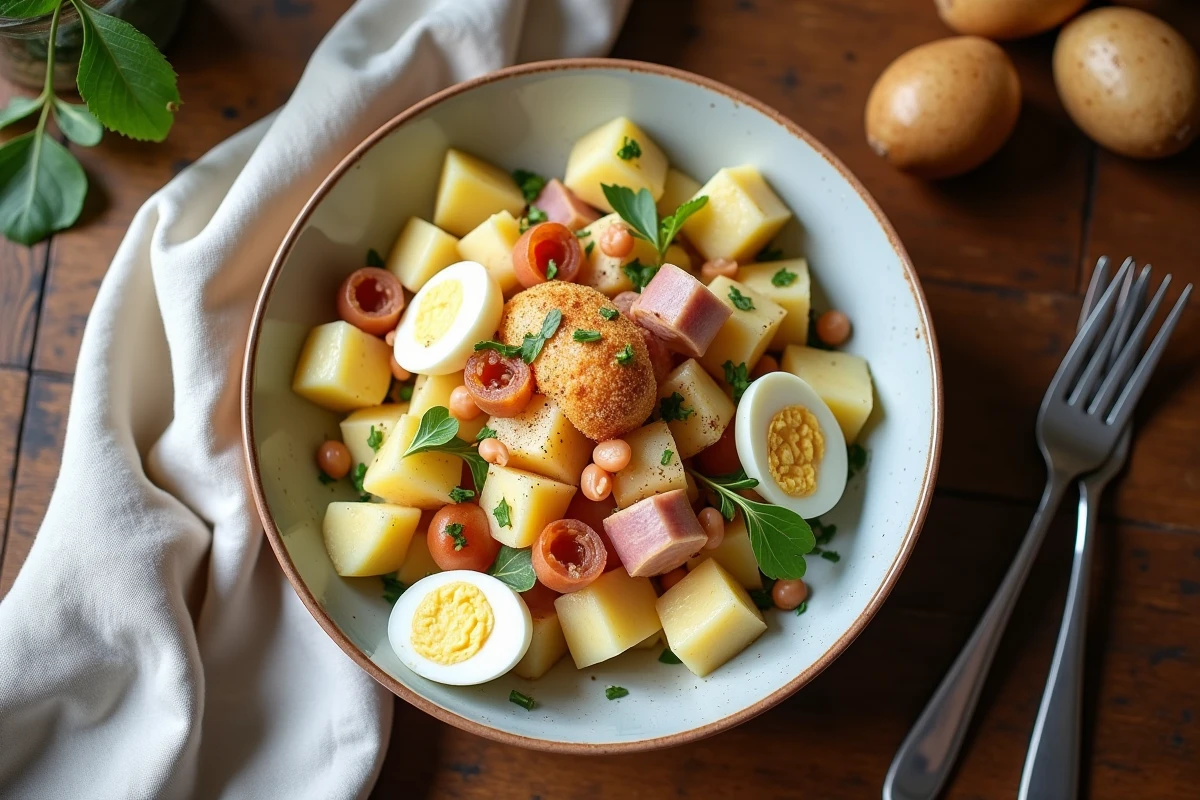
A serving of Piemontese salad has a higher caloric content than most mixed salads. Potatoes, mayonnaise, ham, hard-boiled eggs: the combination of starches, fats, and animal proteins creates a dish that is dense in energy. Understanding the contribution of each ingredient allows for a better assessment of its actual effect on weight.
Energy density of Piemontese salad: the sauce-to-vegetable ratio makes all the difference
The figure displayed “per 100 g” on a container provides partial information. What determines the impact on weight gain is the energy density, meaning the number of calories concentrated in a given volume. Two Piemontese salads may show a similar caloric content per 100 g yet may satiate very differently.
A version rich in mayonnaise and cold cuts, but low in tomatoes, pickles, or raw vegetables, concentrates more calories per bite. The volume occupied in the stomach is small, satiety arrives late, and the amount consumed increases. Conversely, a version where bulky vegetables (tomatoes, green lettuce, pickles) make up a significant portion of the bowl lowers this density. The fibers and water contained in these vegetables increase the volume without adding significant calories.
To assess the impact of a Piemontese salad, one must observe the proportion of potatoes to sauce and vegetables. Cooked potatoes provide moderately caloric starch but absorb mayonnaise like a sponge. The more they dominate the bowl in the absence of raw vegetables, the higher the energy density.
An article detailing the calories of Piemontese salad on Cuisine Gratuite confirms that the distribution of ingredients weighs as much as their nature.

Actual portion in a container or at the salad bar: the trap of underestimated weight
Nutritional values are always listed “per 100 g”. Most consumers imagine they are eating a reasonable portion. In practice, a container from a supermarket often exceeds this reference weight.
At the salad bar or in fast food, the portion approaches a full meal. The amount served can represent two to three times the “100 g” on the label, transforming a salad perceived as light into a caloric intake equivalent to a classic hot dish.
This underestimation of the actual weight of the portion explains why Piemontese salad “grabbed on the go” produces an invisible caloric surplus. The problem does not lie with the dish itself, but with the gap between the imagined portion and the portion actually consumed.
Check the net weight of the container
Turning the packaging over and reading the total net weight, then multiplying the values per 100 g by this weight, provides a realistic intake. This simple step eliminates the most common blind spot in caloric tracking.
Role of mayonnaise and eggs in fat intake
The mayonnaise is the dominant caloric component of the recipe. Composed of oil and egg yolk, it concentrates a high amount of fats per spoonful. Reducing the amount of mayonnaise mechanically lowers the overall caloric intake more than any other modification.
Hard-boiled eggs, on the other hand, provide proteins and fats in more moderate proportions. A whole hard-boiled egg remains a nutritionally interesting ingredient: it contributes to satiety due to its protein content. Removing it to “lighten” the salad deprives one of a satiety lever without a significant caloric gain.
Three concrete levers allow for a reduction in fat intake without altering the dish:
- Replace part of the mayonnaise with plain yogurt or cottage cheese, which halves the lipid load of the sauce while maintaining creaminess
- Measure the mayonnaise with a spoon rather than by eye, as adding “by feel” systematically overestimates the necessary amount
- Keep whole hard-boiled eggs to maintain the protein intake that curbs hunger in the mid-afternoon
Piemontese salad and weight gain: frequency and context of the meal
A dish does not cause weight gain solely due to its composition. The frequency of consumption and the overall dietary context determine the effect on weight. A Piemontese salad consumed once a week in a varied dietary context does not have the same impact as a container eaten daily in addition to an already hearty meal.
During the summer, Piemontese salad often accompanies barbecues, bread, sugary or alcoholic drinks. In this context, it adds to an already high intake rather than replacing it. The cumulative effect goes unnoticed because the word “salad” reassures.
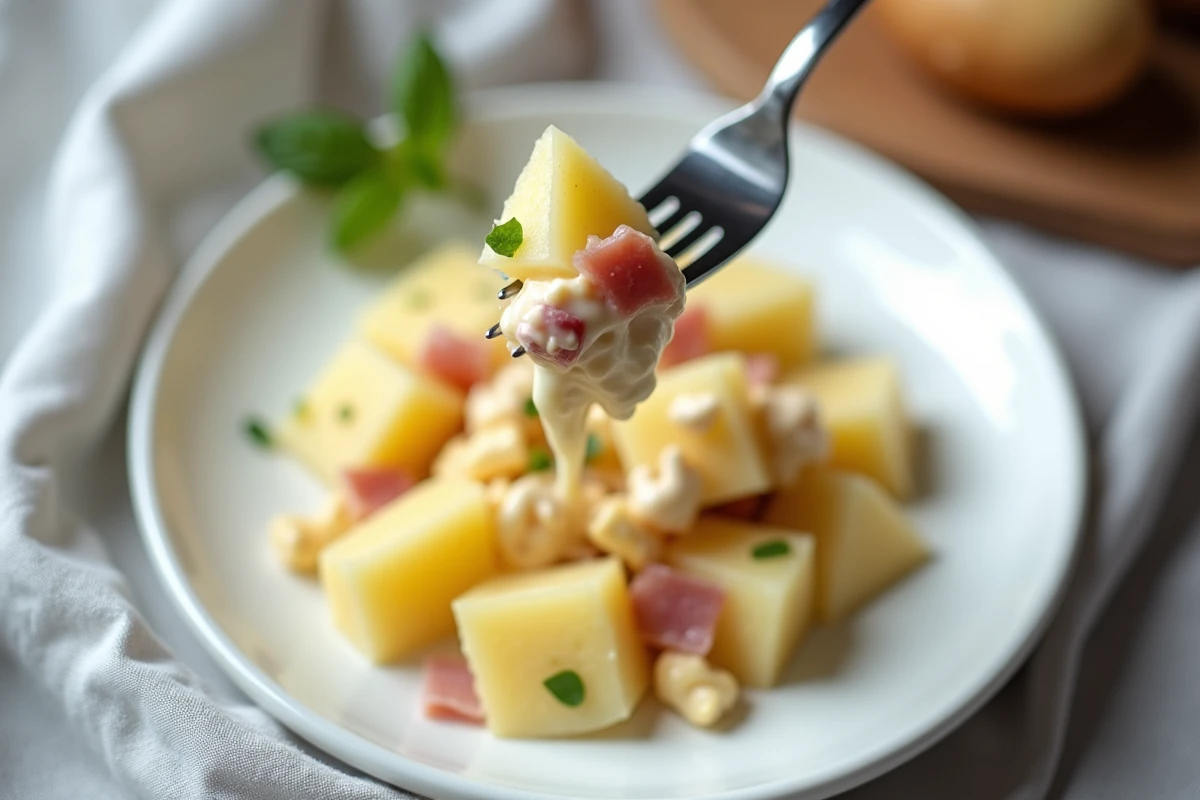
Adapting Piemontese salad to a weight goal
To incorporate this dish without disrupting its intake, a few concrete adjustments make a difference:
- Serve Piemontese salad as a main dish rather than as a side, which limits caloric stacking
- Increase the portion of tomatoes, pickles, and salad leaves to lower the energy density of the bowl
- Favor a homemade version where the amount of mayonnaise and potatoes is controlled, rather than an industrial version where the sauce dosage aims for maximum taste
- Avoid consuming it alongside another starch (bread, chips, rice) to prevent doubling the carbohydrate intake
Piemontese salad remains a caloric dish by nature, driven by mayonnaise and potatoes. Its impact on weight depends less on the recipe itself than on the volume actually consumed, the frequency, and what accompanies it on the plate. Mastering the sauce dosage and checking the weight of one’s portion are the two actions that can significantly change the outcome.